
Introduction
Pages are larger units of content made up of Components. You assemble them in the Page Editor from developer-created Components. Pages often contain the content of a ‘page’ or ‘screen’ in an application, but they can be used for any content.
In this section, you will learn:
-
What a Page is
-
How Components fit into Pages
-
How Component Instructions relate to Content Types
Page overview
A Page is a larger unit of content made up of Components
Pages are built in the Page Editor by dragging Components into a Page Layout. The Web-Page Layout consists of a Head and a Body section, whilst Headless-Page Layout consists of a single Document section. Components can only be inserted into a section that corresponds with their Component Type.
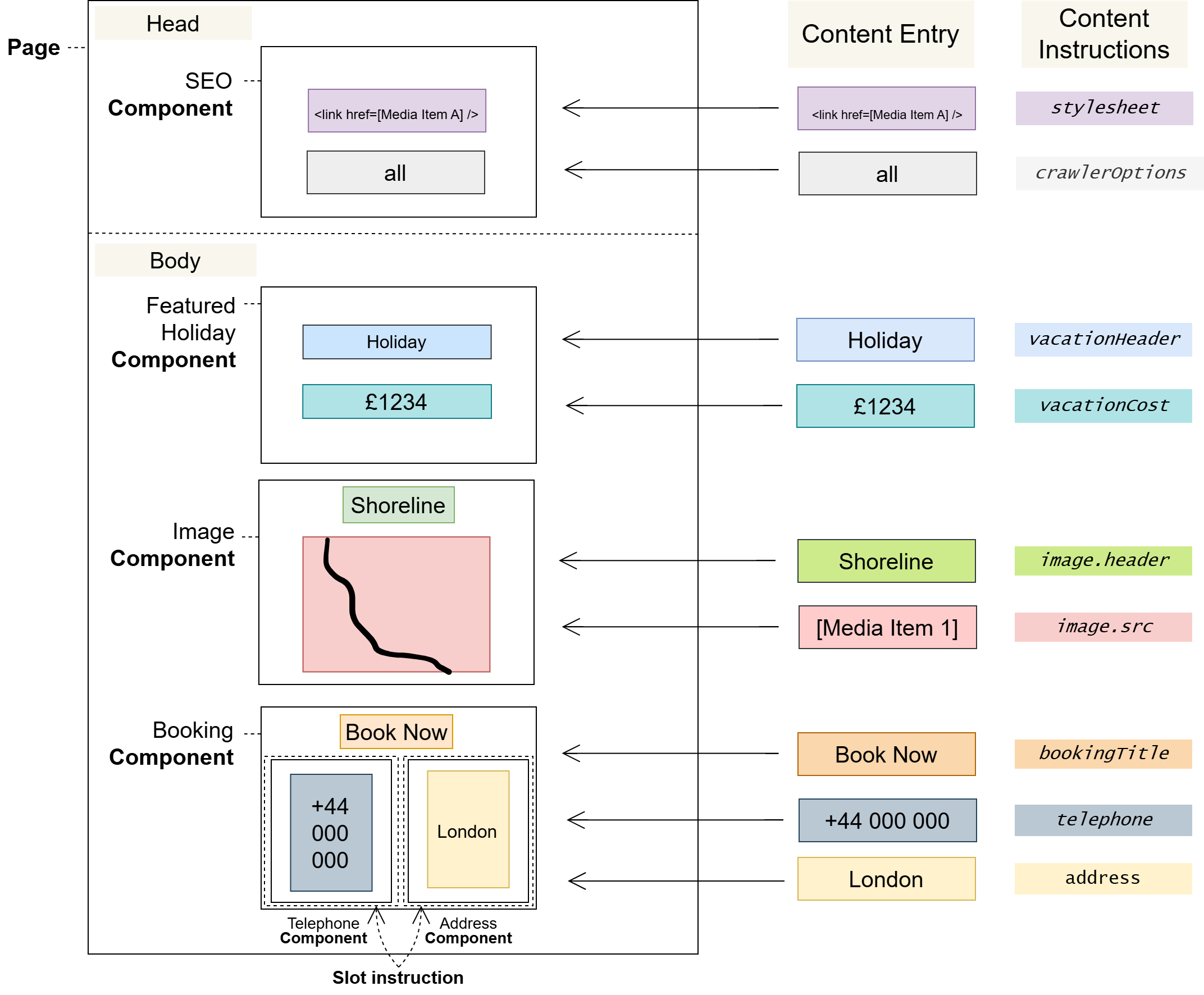
Pages are also made up of Content Entries, that can be inserted in the places where Components have defined Content Instructions based on defined Content types. The values that can be used in a Content Entry depend on the field types defined within the Content type.
Additionally, Locales and can be used to change the Content Entries on a Page. This allows you to tailor Pages to different locales and audiences.
Pages, Components and Content Entries
The following diagram shows how Pages are composed of Components, with values in Content Entries inserted where Content Instructions have been defined.
Notes
Content entries and Slot instructions are filled out by content editors using the Page Editor.
Pages have a route associated with them, which denotes the path they should be available from in Consumer Applications.
User Journeys
Glossary
See the Glossary for more information.